Types of Insurance You Actually Need
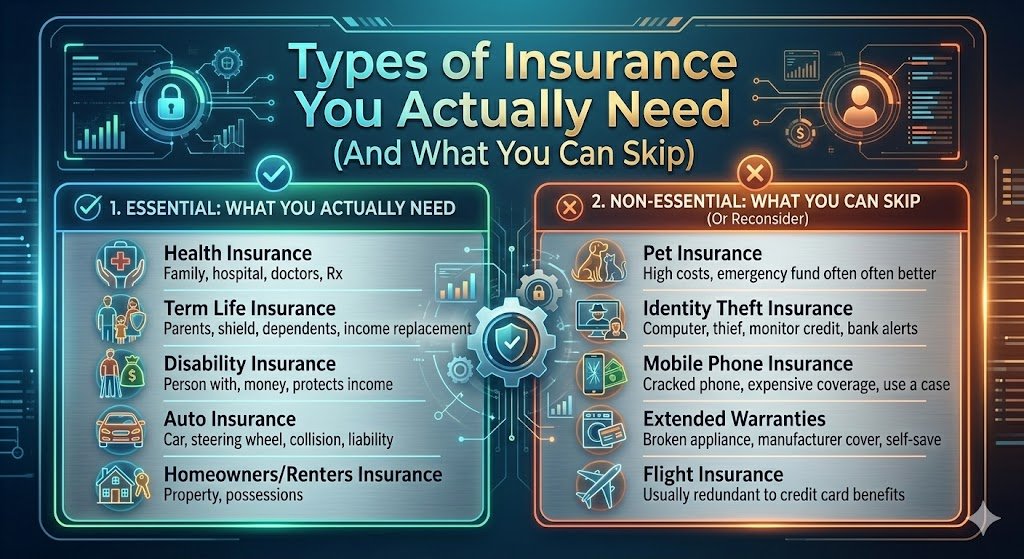
Types of Insurance You Actually Need (And What You Can Skip)
Table of Contents
- Who Is This For?
- A Quick Trust Note
- What You’ll Learn
- Health Insurance: The Non-Negotiable One
- Auto Insurance: More Than Just a Legal Requirement
- Homeowners or Renters Insurance: Don’t Learn This the Hard Way
- Life Insurance: Only If People Depend on You
- Disability Insurance: The One Most Americans Ignore
- Umbrella Insurance: The Affordable Safety Net Nobody Talks About
- Insurance You Probably Do NOT Need
- Common Mistakes People Make With Insurance
- Tools and Apps to Help You Compare and Manage
- Frequently Asked Questions
- Sources Used in This Article
- Helpful Next Steps
By Arshiyan Ahmed | Personal Finance Writer | Updated April 2026
I once watched a coworker lose her apartment’s entire contents to a pipe burst. No renters insurance. She was 27, had a decent job, and assumed “that stuff only happens to other people.” Three weeks later, she was sleeping on an air mattress she borrowed from a friend.
That experience changed how I think about insurance. Not as a boring checklist item, but as a financial decision that can literally decide whether a bad week turns into a bad year.
The problem is that most people either over-insure themselves out of fear, or ignore coverage completely because the premiums feel like money thrown into a black hole. Neither extreme works. After years writing about personal finance and spending time as a licensed insurance agent in Texas, I want to help you figure out what coverage actually makes sense for your life.
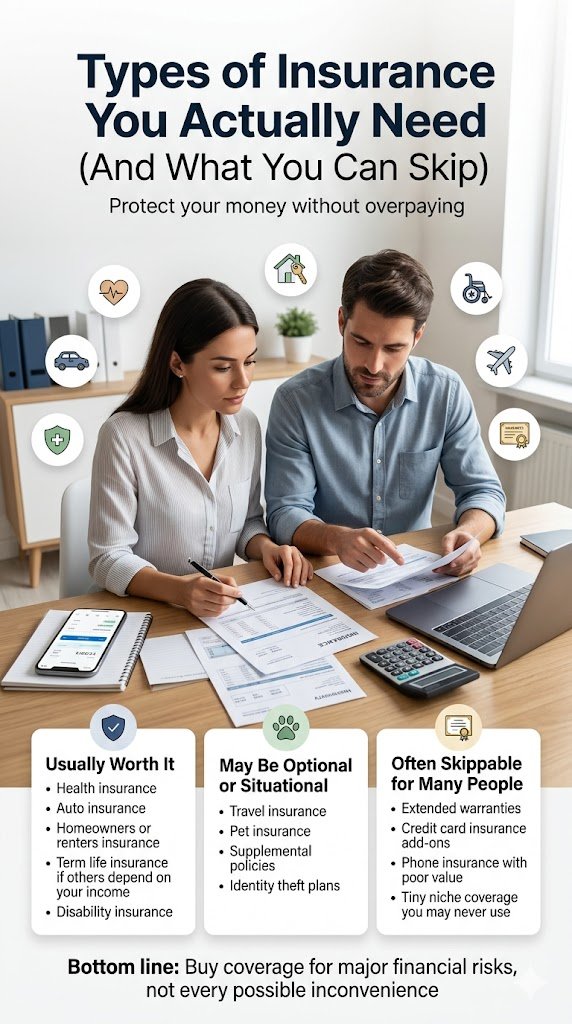
Who Is This For?
This guide is written for regular Americans. Whether you are a 24-year-old renting your first apartment, a family of four trying to tighten the budget, or someone in their 50s who just realized their insurance setup needs a serious review, this is for you.
You do not need a financial planner or a law degree to make good insurance decisions. You just need clarity on what each policy actually does.
A Quick Trust Note
The recommendations in this article are based on personal experience working in insurance sales, advising clients on coverage gaps, and years of reviewing published data from organizations like the Insurance Information Institute and Kaiser Family Foundation. This is not sponsored content. No insurer paid for placement here. You should always compare quotes and read your actual policy documents before signing anything.
What You’ll Learn
- Which insurance policies are genuinely essential for most Americans
- What each type of coverage protects you from in plain language
- Real-world examples of when each policy saves you (and when it does not)
- The policies that are mostly just profit for insurance companies
- Common coverage mistakes that leave people exposed
- Tools you can use today to compare rates and manage your policies
Health Insurance: The Non-Negotiable One
If there is one coverage type you keep no matter what, it is health insurance. A single emergency room visit in the United States can run between $2,000 and $30,000 depending on what happened. A three-day hospital stay for something like appendicitis? Easily $50,000 or more before your insurer touches a cent.
Medical debt is the leading cause of personal bankruptcy in America. That is not an exaggeration. According to research from the American Journal of Public Health, roughly 66% of all personal bankruptcies have a medical issue at their root. Health insurance is not about paying for your annual checkup. It is about making sure a health crisis does not also become a financial crisis.
What to Actually Look For
When you are picking a plan, forget the monthly premium for a second and look at three numbers:
Deductible: The amount you pay out of pocket before insurance kicks in. A plan with a $200 monthly premium but a $7,000 deductible may actually cost you more in a bad year than one with a $450 premium and a $1,500 deductible.
Out-of-pocket maximum: This is the ceiling. Once you hit this number in a year, your insurer covers 100% of covered services. This number is your real protection.
Network coverage: Check whether your actual doctors and nearby hospitals are in-network. Out-of-network bills can arrive months later and feel like a punch in the stomach.
A Real Case
My neighbor Kevin, a 38-year-old freelance contractor in Nashville, went uninsured for one year to save money. He was healthy, gym-going, no chronic conditions. Then he fell off a ladder at a job site. Broken wrist, minor head injury, one night in the hospital. Total bill: $41,000. He is still paying it off through a hardship payment plan four years later. His monthly premium would have been around $320 through the ACA marketplace.
Step-by-Step: How to Get Health Insurance
- Go to healthcare.gov and enter your zip code, household size, and estimated income.
- Review your subsidy eligibility. Many Americans qualify for reduced premiums.
- Compare at least three plans side by side using the built-in comparison tool.
- Pay attention to the summary of benefits document, not just the premium.
- Enroll before the Open Enrollment deadline (usually November 1 through January 15 each year).
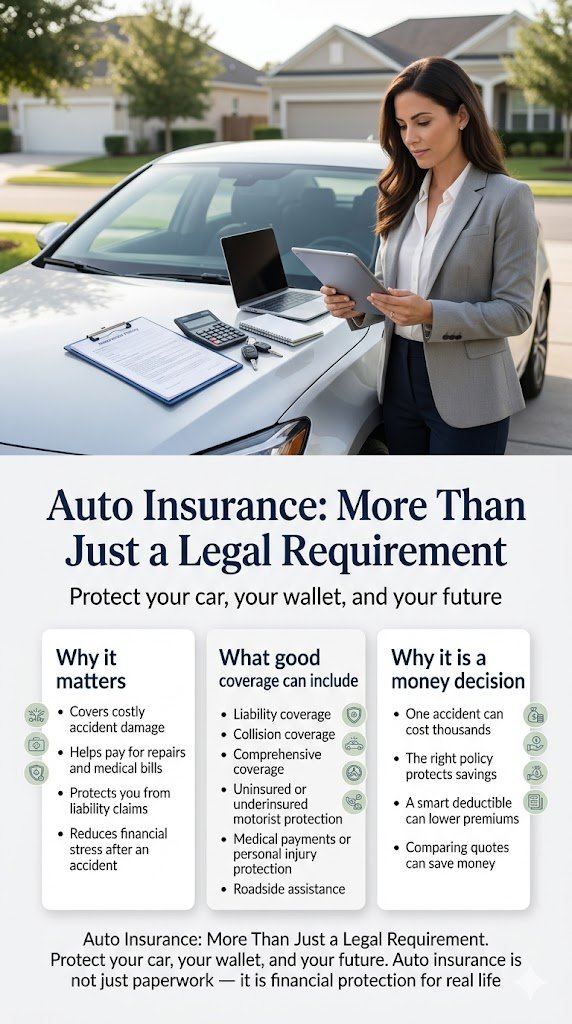
Auto Insurance: More Than Just a Legal Requirement
Every state except New Hampshire requires at least some form of auto insurance. But minimum legal coverage is often not enough to actually protect you.
Here is something most people do not realize: liability coverage, which is the minimum required, only covers the other person when you cause an accident. It does nothing for your own car. If you cause a rear-end collision and your car needs $8,000 in repairs, you pay that entirely out of pocket unless you have collision coverage.
The Coverage Types Worth Understanding
Liability: Covers bodily injury and property damage you cause to someone else. You want higher limits than the state minimum if you have any savings or assets. A judgment against you in a serious accident can go after your bank account.
Collision: Covers damage to your own car after an accident. If your car is older and worth under $4,000 or so, you might skip this one. The math does not always pencil out.
Comprehensive: Covers non-collision events like theft, hail, flooding, and hitting a deer. Very inexpensive in most areas and usually worth keeping.
Uninsured/underinsured motorist coverage: This one is underused and underrated. About one in eight American drivers is uninsured. If one of them hits you, this coverage steps in where their nonexistent policy cannot.
A Practical Example
Danielle, a teacher in Phoenix, had the state minimum coverage on her 2020 Honda Civic. A hit-and-run driver totaled it in a parking garage. Because she had uninsured motorist property damage coverage, she walked away with $18,500 to replace the car. Without it, she would have been dealing with a totaled car and no recourse. Adding that coverage cost her about $12 extra per month.
Homeowners or Renters Insurance: Don’t Learn This the Hard Way
Back to my coworker with the flooded apartment. Renters insurance is one of the cheapest and most overlooked policies available. The average cost is roughly $15 to $20 per month. For that, you typically get coverage on your personal belongings, liability protection if someone gets hurt in your apartment, and sometimes temporary housing if your place becomes uninhabitable.
Homeowners insurance is more complex and more expensive, but equally critical. Your mortgage lender actually requires it. Beyond that, a standard policy covers your dwelling structure, your personal property, liability, and additional living expenses if you are displaced.
What Most People Miss
Standard homeowners policies do not cover floods or earthquakes. Those require separate policies or riders. The FEMA flood map for your area (available at msc.fema.gov) is worth checking, especially if you are anywhere near a river, coastline, or low-elevation area.
After Hurricane Harvey hit Houston in 2017, hundreds of thousands of homeowners discovered their policies did not cover flood damage. Many of them were not even in a designated flood zone. The National Flood Insurance Program exists precisely for this reason, and premiums can start as low as a few hundred dollars per year in low-risk areas.
Step-by-Step: Getting Renters Insurance
- Estimate the value of your belongings. Walk through each room and write down major items.
- Get quotes from at least two or three companies. Apps like Lemonade, Toggle, and State Farm’s mobile app make this fast.
- Choose between replacement cost coverage (what it costs to buy new) versus actual cash value (what your stuff is worth used). Always pick replacement cost if you can afford it.
- Look for bundling discounts if you also have auto insurance. Bundling often saves 10 to 20%.
Life Insurance: Only If People Depend on You
Life insurance is essential if other people rely on your income. Full stop. If you are single, have no children, and your death would not leave anyone financially worse off, then life insurance is not urgent. If you have a spouse, kids, aging parents you support, or a mortgage co-signer, it moves to the top of the priority list.
Term Versus Whole Life
This debate has filled entire books. Here is the short version: for most families, term life insurance is the right choice. You pay a set premium for a fixed period (usually 20 or 30 years), and if you die during that time, your beneficiaries receive the death benefit.
Whole life insurance builds cash value over time, but the fees are high, the returns are modest, and it is far more complex than most families need. The phrase “buy term and invest the difference” became a cliche in financial planning circles for a reason. It usually works.
How Much Coverage Is Enough
A common rule of thumb is 10 to 12 times your annual income. That said, think about what your family would actually need. Remaining mortgage balance, years until your youngest child is independent, any debts. A term policy for a healthy 35-year-old non-smoker can cost as little as $25 to $35 per month for $500,000 in coverage.
Tools like Policygenius let you compare quotes from multiple insurers in under 10 minutes without talking to a sales agent.
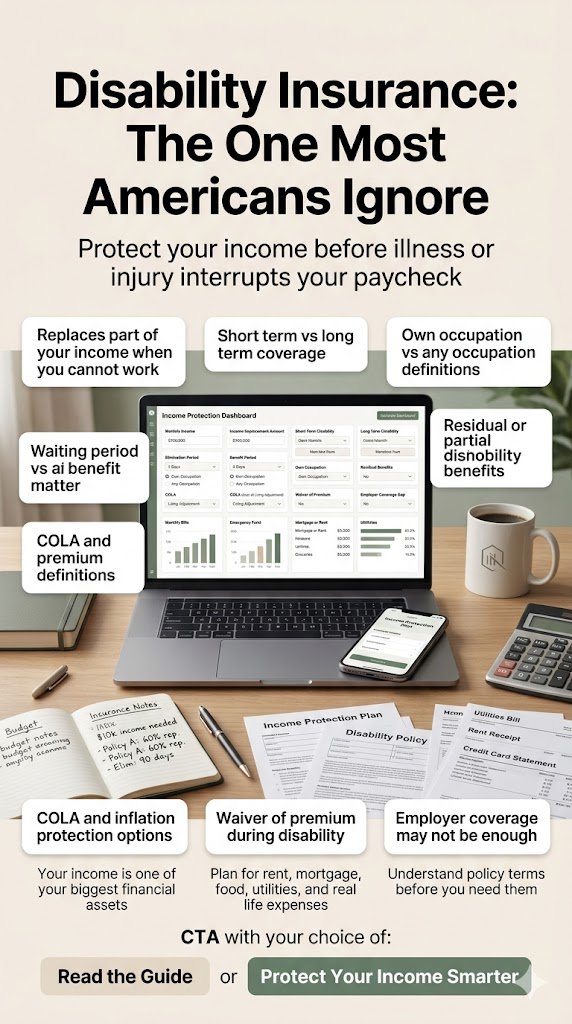
Disability Insurance: The One Most Americans Ignore
Here is a statistic that stops people cold: you are three and a half times more likely to experience a disability that prevents you from working than to die before retirement age. Yet life insurance gets all the attention.
Disability insurance replaces a portion of your income if an illness or injury prevents you from working. Most policies cover 60 to 70% of your gross income. Social Security disability exists but the approval process is notoriously slow and the benefits are often modest.
If your employer offers long-term disability coverage as a benefit, enroll in it. If they do not, look into an individual policy. It is particularly critical for self-employed individuals, freelancers, and anyone in a physically demanding occupation.
A Case That Made Me a Believer
A financial advisor I knew in Dallas, healthy and in his early 40s, was diagnosed with multiple sclerosis. He was completely unable to work for almost two years. His long-term disability policy from work replaced 60% of his income during that stretch. Without it, he said his family would have burned through their savings within nine months.
Umbrella Insurance: The Affordable Safety Net Nobody Talks About
An umbrella policy kicks in when your underlying auto or homeowners liability limits run out. Say you cause a serious car accident and the injured party sues you for $1.2 million. If your auto policy only covers $300,000 in liability, the extra $900,000 comes from your umbrella policy.
A $1 million umbrella policy typically costs between $150 and $300 per year. That is genuinely one of the best deals in the insurance world. It is especially useful if you have significant assets, a swimming pool, a trampoline, teenage drivers, or a dog breed that raises liability flags.
Insurance You Probably Do NOT Need
Just as important as knowing what to buy is knowing what to skip.
Extended warranties on electronics: These are almost pure profit for the retailer. Most electronics fail either immediately (within the manufacturer warranty window) or long after the extended warranty expires.
Credit card payment protection insurance: High premiums, full of exclusions, and the benefit is usually just making your minimum payment for a few months. It is rarely worth the cost.
Pet insurance for healthy young pets: The math rarely works in the owner’s favor for routine care. It can make sense for breeds prone to expensive conditions, but do the numbers before signing up.
Mortgage life insurance: This is a policy designed to pay off your mortgage if you die. The problem is that the coverage declines as you pay down the mortgage, but the premium usually stays the same. A standard term life policy does the same job more efficiently.
Travel insurance for domestic trips: For short domestic trips, it is usually not worth it. For international travel, extended trips, or expensive prepaid vacations, the calculation changes.
Common Mistakes People Make With Insurance
Choosing the cheapest premium without looking at the deductible. A low monthly cost can mean massive out-of-pocket exposure when you actually need the coverage. Always run the worst-case scenario before deciding.
Not updating coverage after major life changes. Got married? Had a child? Bought a house? Your insurance needs shift dramatically. Review your policies after any major life event.
Not reading the exclusions section. The exclusions in a policy tell you what is NOT covered. That section matters at least as much as the marketing language about what is included.
Carrying too little liability coverage because you do not think you have enough assets to protect. Future earnings are also at risk in a judgment. A lawsuit can follow you.
Skipping renters insurance because your landlord has insurance. Your landlord’s policy covers the building, not your belongings or your personal liability.
Tools and Apps to Help You Compare and Manage
Policygenius: Best for comparing term life and health insurance. Free to use, no spam calls.
The Zebra: Auto and home insurance comparison. Pulls real quotes from multiple carriers.
Lemonade: Surprisingly good renters and homeowners insurance with a smooth app experience. Fast claims process.
healthcare.gov: The official ACA marketplace for health insurance comparisons and subsidy information.
USAA: If you or a family member served in the military, USAA consistently ranks at the top for auto and homeowners insurance value and customer service.
Empower (formerly Personal Capital): While primarily a wealth tracker, it helps you see your full financial picture, which informs how much coverage you actually need.
Frequently Asked Questions
Do I need life insurance if I am single with no dependents? Not urgently. If you have co-signed debt or want to leave money to someone, it might make sense. Otherwise, focus on health and disability coverage first.
Can I have health insurance and still get hit with huge medical bills? Yes. Balance billing, out-of-network charges, and services not covered by your plan can still create significant costs. Always verify that providers are in-network before a non-emergency procedure.
Is pet insurance worth it? Depends on the breed and your financial cushion. For breeds with known genetic conditions, certain larger dogs, or if a major vet bill would put you in debt, it can be worth exploring. For a mixed breed young dog with no known issues, self-insuring (setting aside a small emergency fund for vet costs) often makes more sense.
How often should I review my insurance coverage? Once a year at minimum. Do it around the same time each year so it becomes a habit. Also review after any major life change.
What does umbrella insurance actually cover? It covers personal liability beyond the limits of your home and auto policies. Injuries on your property, serious car accidents, certain lawsuits, and in some cases even defamation claims. It does not cover your own injuries, intentional acts, or business liability.
Sources Used in This Article
- Insurance Information Institute (iii.org): Industry data on coverage types, costs, and claims statistics
- Kaiser Family Foundation (kff.org): Health insurance cost and coverage research
- FEMA National Flood Insurance Program (floodsmart.gov): Flood risk and coverage information
- American Journal of Public Health: Research on medical debt and bankruptcy
- Bureau of Labor Statistics: Disability risk statistics for working-age Americans
- healthcare.gov: ACA enrollment and subsidy information
Helpful Next Steps
If you want to take action today rather than let this article become another tab you meant to revisit, here is a simple three-step path forward:
Start with your health insurance. If you do not have it or are underinsured, go to healthcare.gov and check your subsidy eligibility this week. Even if Open Enrollment has passed, a qualifying life event may let you enroll outside the standard window.
Then check your renters or homeowners policy. Pull out the declarations page and look at your personal property limit, your liability limit, and your deductible. Ask yourself if those numbers make sense given what you own and what you earn.
After that, use Policygenius to get a free term life quote, especially if you have a spouse or children depending on your income. You may be surprised how affordable it is.
Insurance is one of those things that feels like a waste until the exact moment it is not. You are not buying a policy for the average week. You are buying it for the one that changes everything.
