How to Audit Your Monthly Subscriptions and Stop Wasting Money
How to Audit Your Monthly Subscriptions and Stop Wasting Money
A few months ago, I did something I should have done far earlier. I sat down with tea, my laptop, my phone, and three months of bank statements. I thought the whole exercise would take twenty minutes. I was wrong.
What started as a quick money tidy up turned into a small financial excavation. It felt a bit like cleaning out a shed and finding five rakes, two broken pots, and a bag of compost you forgot you bought. I found a music app I had not opened in nearly a year. A cloud storage plan I upgraded during a busy work week and never scaled back. A free trial that had quietly grown into a regular bill. One service was only 4 dollars a month, which sounds harmless until you realize twelve harmless things can team up and mug your budget in broad daylight.
That is the sneaky thing about subscriptions. They rarely look dramatic on their own. They drip, they do not flood. But month after month, they can turn your budget into a leaky watering can.
And it is not just you or me. A C plus R Research survey found that people guessed they spent 86 dollars a month on subscriptions, but when they listed everything out, the real average was 219 dollars. The average gap was 133 dollars. The same study found that 74 percent said recurring charges were easy to forget, and 42 percent admitted they had kept paying for a service they were no longer using.
That is why a subscription audit matters. Not because every subscription is bad. Some are worth every penny. I happily pay for a few that save me time, help me work, or make life easier. The problem is not the concept. The problem is the clutter.
The mistake most people make
Most people audit subscriptions with memory. That is the first trap.
We sit there and say, “I have Netflix, maybe Spotify, maybe cloud storage, and that is probably it.” That is not an audit. That is a guess dressed up as confidence.
Memory misses the boring ones. It misses annual renewals. It misses the upgrade you accepted while half asleep. It misses the app billed through your phone instead of your card. It misses the old account linked to a second email address.
I made all those mistakes.
For a long time, I thought I was being sensible because I did not have many flashy expenses. I cooked at home, skipped random shopping, and did not go wild with gadgets. Meanwhile, my bank account was quietly supporting digital squatters. The money was not disappearing with fireworks. It was drifting away like leaves in a pond.
A real world case study worth paying attention to
That C plus R Research study is useful because it mirrors what happens in real life. People are not usually reckless. They are busy. They sign up for convenience, then life moves on. A service that felt useful during exam season, travel season, a fitness kick, or a work deadline can keep billing long after that chapter ends.
There is also a reason subscription cancellation has become such a consumer issue. In October 2024, the US Federal Trade Commission announced a final click to cancel rule designed to make it as easy to cancel as it was to sign up. The FTC said it receives thousands of complaints about recurring subscription practices each year, and in 2024 it was getting nearly 70 consumer complaints per day on average, up from 42 per day in 2021.
That tells me two things. First, this is a common problem, not a personal failure. Second, some companies know very well that people forget, delay, or give up halfway through cancellation.
So, let us make sure you are not the ideal customer for that kind of business model.
The easiest way to audit your subscriptions without losing your mind
You do not need fancy software for this. A notes app, Excel, Google Sheets, or even a notebook will do. I usually use a laptop, my banking app, Gmail, and my phone app store subscriptions page.
Here is the method that worked for me.
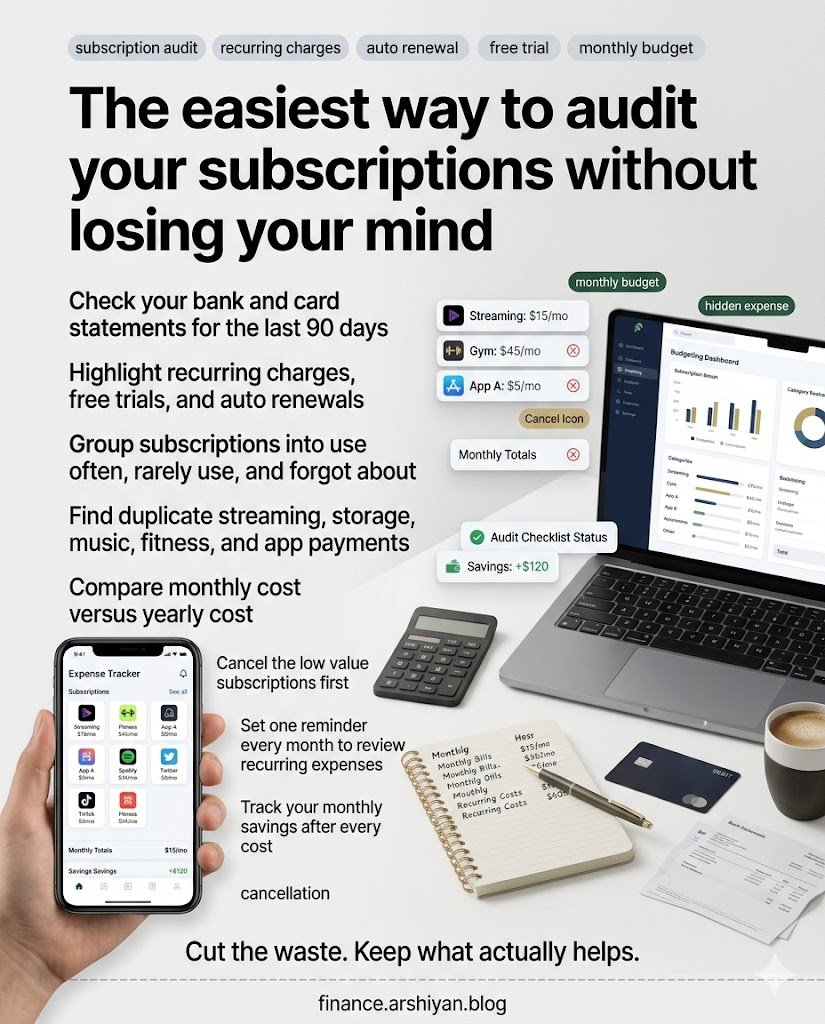
Step 1: Pull your money trail, not your memory
Open the last three months of statements from your bank account and credit card. If you use an app like Monzo, Revolut, Chase, HBL, UBL, or any other banking app with search, even better.
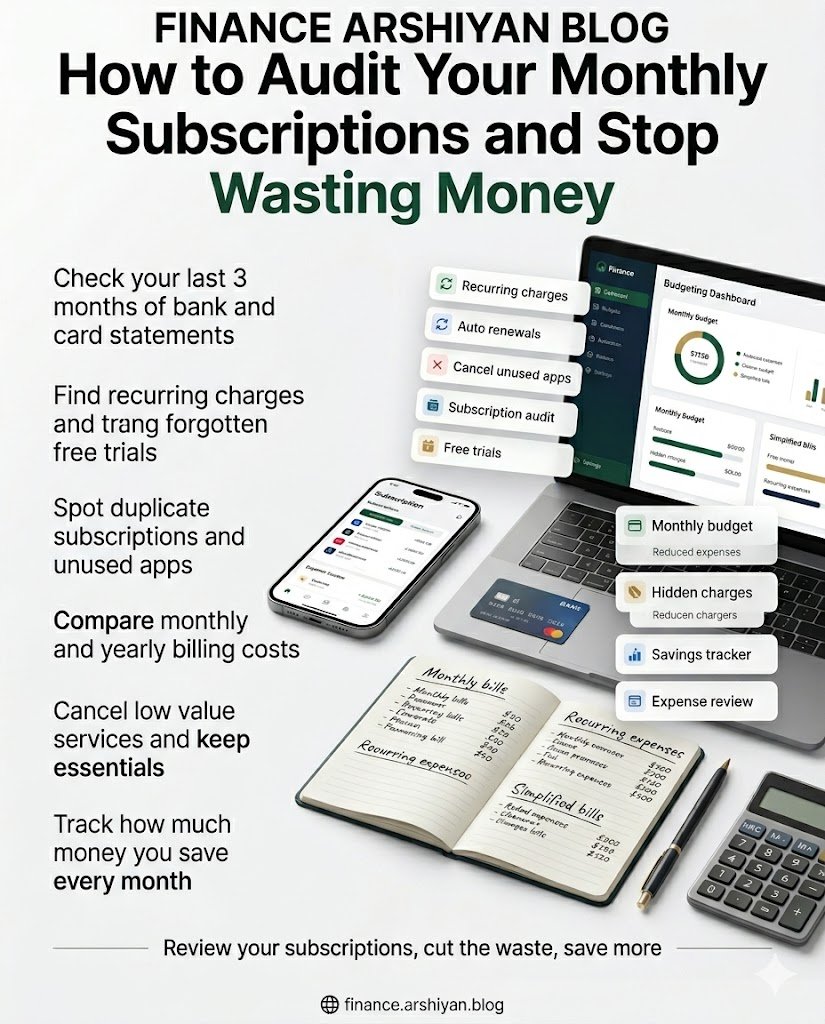
Search for recurring charges. Look for the same amount or merchant name appearing every month. Pay attention to these categories:
Streaming services
Music and audio
Cloud storage
Productivity tools
Canva and design apps
AI tools
Fitness apps
Meal plans
Gaming memberships
Website tools
Domain and hosting renewals
News and learning platforms
Phone and app store billing
Do not forget your iPhone or Android subscription page. Many people miss charges billed through Apple or Google because they are not always obvious on a bank statement.
When I did this, I found one subscription billed directly to my card, one billed through Google Play, and another coming from PayPal. Three different doors, same house.
Step 2: Make one ugly list before you make a pretty one
Do not try to organize everything perfectly at first. Just dump it all into one list.
Use these columns:
Service name
Monthly cost
Billing date
How you pay
Last time you used it
Keep, cancel, or review
That last column matters. You are not making final decisions yet. You are only bringing the suspects into one room.
Here is a practical example.
YouTube Premium, 12 dollars, card, used yesterday, keep
Canva Pro, 13 dollars, card, used last week, keep
Meditation app, 8 dollars, Apple billing, used three months ago, review
Extra cloud storage, 3 dollars, Google billing, no idea, review
Language app, 10 dollars, PayPal, used once in January, cancel
Now the fog starts to lift.
Step 3: Turn the monthly number into an annual number
This step is where the penny drops.
A 7 dollar subscription feels small. A 15 dollar one feels manageable. But when you multiply by twelve, the story changes.
That 7 dollar app is 84 dollars a year.
That 15 dollar service is 180 dollars a year.
Five “small” subscriptions can quietly become 500 to 800 dollars a year without breaking a sweat.
When I did this, the shock was not the biggest charge. It was the pile of medium and tiny ones. Individually they looked like pocket lint. Together they were a proper chunk of money.
This is the moment when many people realize they are not cutting joy. They are cutting dead weight.
Step 4: Ask one brutal question
Would I sign up for this again today at the current price?
Not “Did I once like it?”
Not “Might I use it soon?”
Not “Is it only a few dollars?”
Would I pay for it again today?
That question is sharp enough to cut through excuses. I had one writing tool I kept because I liked the idea of being the sort of person who used it. In reality, I had not opened it in months. I was paying for fantasy self improvement.
That happens a lot. We do not just subscribe to services. We subscribe to versions of ourselves.
The runner.
The language learner.
The organized meal prep person.
The person who meditates at sunrise.
Sometimes those identities stick. Often they do not. Your bank account should not be funding abandoned hobbies like a museum grant.
Step 5: Sort each subscription into three buckets
I like three simple groups.
Keep
These are the ones you use often and would happily pay for again. A good example is cloud storage you actually need for work, or a music service you use every day.
Pause or downgrade
These are useful, but not at the current plan. Maybe you can switch to a cheaper tier, move from family to individual, or pause for a month or two.
Cancel
These are the passengers, not the drivers. You barely use them, forgot about them, or kept them out of habit.
One of my best savings came from downgrading, not canceling. I had upgraded a storage plan during a big project because I needed extra space for video files. The project ended. The bigger bill stayed. Dropping back down took two minutes and saved me money every month.
Step 6: Cancel the hard ones first
This sounds backwards, but it works.
Easy cancellations give you a nice feeling. Hard cancellations save your patience. Tackle the annoying ones while your motivation is fresh.
Open the service, go to account, billing, or membership, and follow the cancellation steps. Take screenshots if needed. Save any confirmation email. Put the final billing date in your calendar.
If a company makes you jump through hoops, do not let the friction win. The FTC said its 2024 final rule was meant to make cancellation as easy as sign up, and part of the reason was the steady stream of complaints about recurring subscription practices.
Even with better rules, your best defense is still attention.
Step 7: Check your email for sneaky renewals
Search your inbox for words like:
welcome
receipt
renewal
membership
subscription
trial ending
billing
You will be amazed what shows up.
I once found an old domain renewal notice buried in my inbox. I had parked a project idea and forgotten about it. The idea had died a peaceful death. The billing had not.
Email is often where the ghosts live.
Step 8: Create one simple rule for future sign ups
This part matters more than the audit itself.
After I cleaned up my list, I made one rule. I do not start a new subscription without writing down three things:
The price
The renewal date
The reason I need it
That tiny pause saves me from impulse sign ups. It also helps later, because I can look back and see whether the reason still holds.
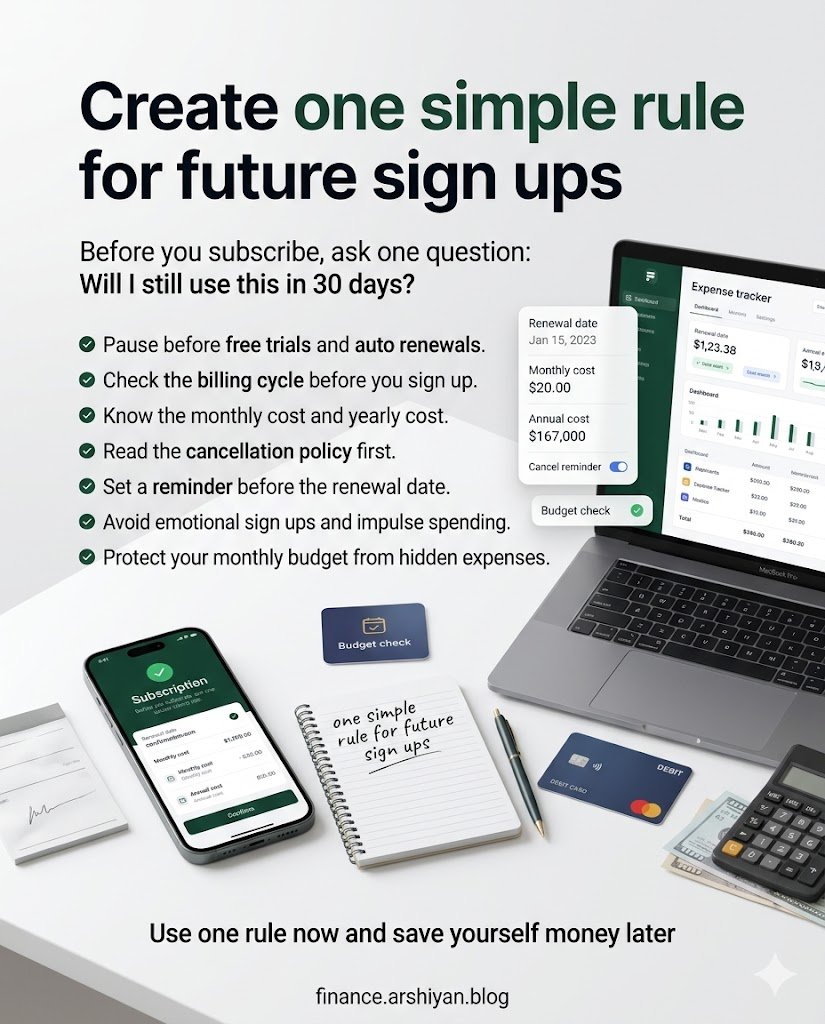
Some people go further and keep all subscriptions on one card. That can be smart. It makes tracking easier. Others set calendar reminders three days before renewal. Also smart. Pick a system you will actually use.
What results can you realistically expect
You do not need dramatic numbers for this to be worth it.
My own audit did not produce a movie scene where trumpets played and money rained from the sky. It was quieter than that. I canceled two services, downgraded one, and removed one old renewal. My monthly savings were not life changing on paper, but they were real. More importantly, I stopped paying for things that had slipped into the budget unnoticed.
For many people, realistic results look like this:
Saving 20 to 50 dollars a month from obvious cuts
Saving more by downgrading plans instead of deleting everything
Feeling calmer because you finally know what is leaving your account
Building a budget that reflects your real life, not your forgotten sign ups
That last one is the gold.
Common mistakes that keep people stuck
One mistake is focusing only on entertainment subscriptions. The bigger leaks are often work tools, storage, app upgrades, and forgotten annual renewals.
Another mistake is canceling useful services and keeping useless ones. Do not cut the thing that helps you earn, sleep better, or stay organized just because it is visible. Cut the service that adds little value.
Another classic error is thinking the amount is too small to matter. Small monthly charges are exactly how waste hides.
And here is a sneaky one. People often audit once, feel virtuous, then never check again. Subscriptions grow back like weeds after rain. A quick review every three or four months keeps the garden tidy.
Quick FAQ
How often should I audit my subscriptions?
Every three to four months is a good rhythm for most people. If your income is tight or you sign up for lots of trials, do it monthly.
Should I cancel everything non essential?
No. The goal is not to live like a monk with a cracked phone screen and no music. Keep what you truly use and enjoy. Cut what has gone stale.
What about annual subscriptions?
Treat them seriously. They are easier to miss because they do not show up every month. Divide the yearly cost by twelve so you can compare them fairly with monthly charges.
Are subscription tracking apps worth it?
They can be. But even if you use one, still do a manual check now and then. Apps are helpful assistants, not infallible detectives.
What if I share plans with family?
Then include your actual share in the audit. A family plan can still be worth it, but only if everyone is really using it and the setup still makes sense.
The bigger lesson
A subscription audit is not just about trimming bills. It is a reality check. It shows whether your spending matches your life right now, not the life you had six months ago, not the life you hoped to have, and not the life a clever free trial page sold you.
That is why I keep coming back to it.
Money waste is rarely loud. It is usually quiet, polite, and automatic. It sits in the corner and keeps charging until somebody notices.
So make a cup of tea, open your statements, and go looking. There is a decent chance your budget is carrying a few passengers that should have gotten off ages ago.
