Financial Guides
Financial Guides: Everything I Wish Someone Had Told Me About Managing Money
I remember sitting at my kitchen table five years ago, staring at a pile of credit card statements, a student loan document, and a paycheck that felt like it evaporated the second it hit my bank account. Nobody in my family talked about money. School never taught me how to budget. And every “financial guide” I found online read like a boring textbook written by someone who had never actually struggled with money.
That experience is exactly why I built this page. This is not another recycled list of “save more, spend less” tips. This is a real, practical, experience driven walkthrough of how to actually get your finances together, step by step, whether you are starting from zero or trying to level up what you already know.

Why Most People Avoid Financial Planning (And Why That Costs Them)
Let me be honest. Money is emotional. It is tied to our self worth, our relationships, and our sense of security. When someone tells you to “just make a budget,” it feels about as helpful as telling a drowning person to “just swim.”
The real reason most people avoid financial planning is not laziness. It is overwhelm. There are thousands of apps, strategies, investment vehicles, and opinions out there. It feels like trying to drink from a fire hose.
But here is the thing I learned the hard way: ignoring your finances does not make them go away. It makes them worse. That credit card balance I avoided checking for months? It quietly ballooned from $4,200 to $6,800 thanks to compound interest working against me. Compound interest is a beautiful friend when it is on your side and a merciless enemy when it is not.
Step One: Know Your Numbers
Before you do anything else, you need to know exactly where you stand. I call this the “financial selfie” because it is an honest snapshot of your money life, no filters allowed.
Here is how to take yours:
- Open your bank statements from the last three months. Most banking apps like Chase, Bank of America, or even fintech platforms like SoFi let you download these easily.
- Write down your total monthly income after taxes. If your income varies, use the average of your last three months.
- List every single recurring expense. Rent, utilities, subscriptions, insurance, minimum debt payments, groceries, gas, everything.
- List your debts with the balance and interest rate for each one.
- Check your savings. Emergency fund, retirement accounts, investment accounts, and that random jar of coins on your dresser all count.
When I first did this exercise, I discovered I was spending $47 a month on streaming services I had forgotten about. I also realized my “small” daily coffee habit was costing me roughly $120 a month. Those numbers do not lie, and they do not judge. They just tell you the truth.
Related Post: [How to Track Your Expenses Without Losing Your Mind]
Step Two: Build a Budget That Actually Works
I have tried every budgeting method you can imagine. Spreadsheets, apps, the envelope system, even writing expenses on sticky notes (do not recommend that one). After years of trial and error, I have learned that the best budget is the one you will actually stick with.
For beginners, I strongly recommend the 50 30 20 framework as a starting point. It works like this:
50% of your after tax income goes to needs. These are non negotiable expenses like housing, food, transportation, minimum debt payments, and insurance.
30% goes to wants. Dining out, entertainment, hobbies, that new pair of shoes you have been eyeing. Life is not meant to be miserable.
20% goes to savings and extra debt payments. This is where you build your future.
Now, let me be real. When I first tried this, my “needs” category alone ate up about 70% of my income. I was living in an expensive city and my rent was bleeding me dry. If the 50 30 20 split does not fit your current situation, do not stress. Adjust the percentages to match your reality and work toward the ideal ratio over time.
Tools that helped me the most: YNAB (You Need a Budget) completely changed how I think about money. It forces you to assign every dollar a job before you spend it. Mint is another solid free option for tracking, though it is more of a rearview mirror than a steering wheel. For people who want simplicity, even a basic Google Sheets template can do the trick.
Related Post: [Best Budgeting Apps for Beginners in 2026]
Step Three: The Emergency Fund Is Not Optional
I used to think emergency funds were for paranoid people. Then my car broke down, I needed $1,800 in repairs, and I had exactly $212 in savings. That experience taught me a lesson credit cards cannot buy.
Your emergency fund is a buffer between you and life is inevitable curveballs. Job loss, medical bills, car repairs, a broken water heater in January. These things are not “if” scenarios. They are “when” scenarios.
Here is my recommended approach:
Start with a mini emergency fund of $1,000. This is your starter shield. Park it in a high yield savings account. Platforms like Marcus by Goldman Sachs, Ally Bank, or Capital One 360 currently offer rates above 4% APY, which means your money actually grows while it sits there.
Once your high interest debt is under control, build up to three to six months of essential expenses. If you are a freelancer or have an irregular income, lean toward six months or even more.
One trick that worked wonders for me: I set up an automatic transfer of $50 every payday into my emergency fund. It was small enough that I barely noticed it, but over a year, that added up to $1,300 without me having to think about it. Automation is genuinely the secret weapon of personal finance.
Related Post: [How to Build an Emergency Fund from Scratch]
Step Four: Attack Your Debt Strategically
Not all debt is created equal. A mortgage at 3.5% interest is a completely different animal than a credit card charging you 24.99%. Understanding this distinction is half the battle.
There are two popular debt payoff strategies, and both work. The right one depends on your personality.
The Avalanche Method means you pay minimums on everything and throw extra money at the debt with the highest interest rate first. Mathematically, this saves you the most money over time. I used this method to pay off $14,000 in credit card debt over 18 months. By targeting my 24.99% card first, I saved roughly $2,100 in interest compared to just making minimum payments.
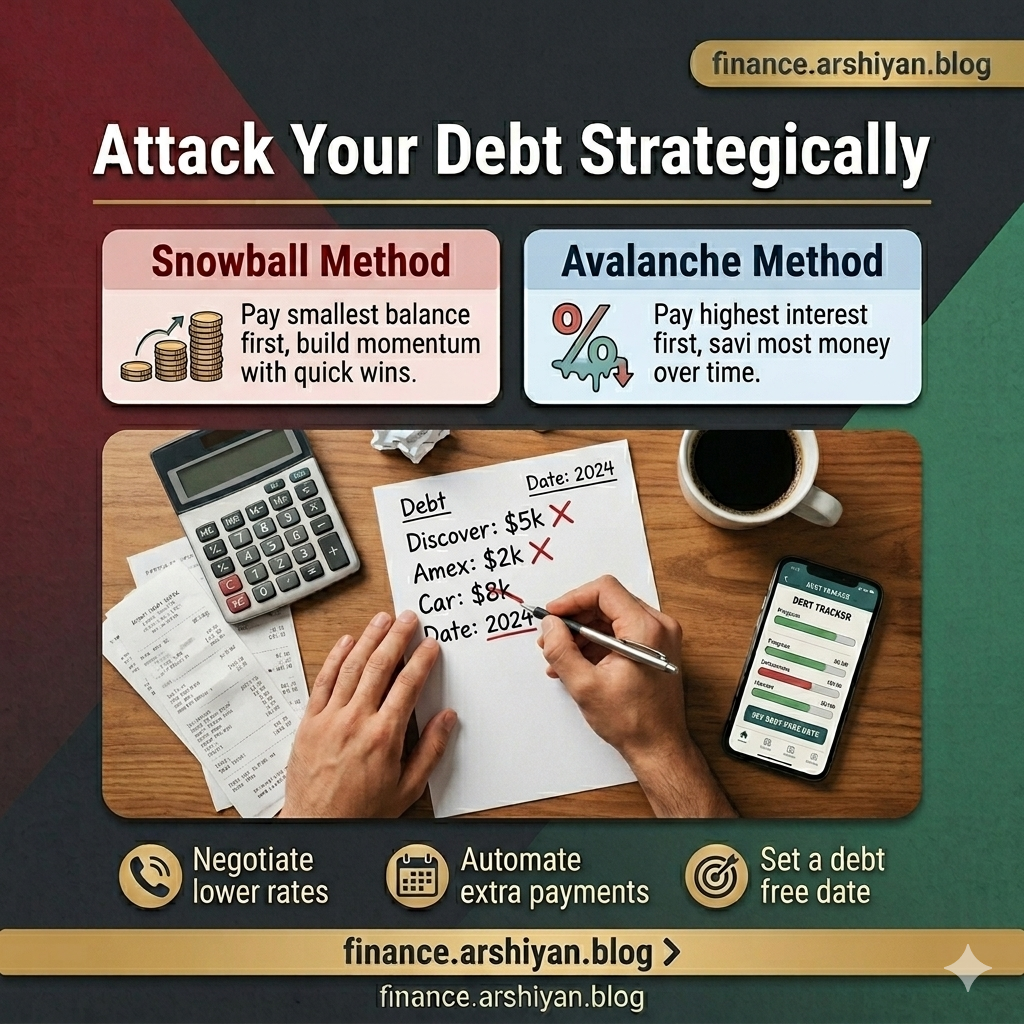
The Snowball Method means you pay off the smallest balance first regardless of interest rate. The logic here is psychological. Quick wins build momentum. If you have five debts and knock out the smallest one in two months, that motivation can carry you through the harder slog of bigger balances.
I personally started with the snowball method because I needed those early wins to keep me going. After paying off two smaller debts, I switched to the avalanche method for the rest. There is no rule saying you cannot mix and match.
One thing I wish I had done sooner: calling my credit card companies to negotiate lower interest rates. I felt embarrassed to even try, but one five minute phone call got my rate dropped from 24.99% to 17.99%. That is a significant difference over time, and all I had to do was ask.
Related Post: [Debt Snowball vs Debt Avalanche: Which Strategy Wins]
Step Five: Start Investing Even If You Feel Broke
This is where most financial guides lose people. Investing sounds like something rich people do in fancy suits. But the truth is, you can start investing with as little as $5 today, and delaying it is one of the most expensive mistakes you can make.
Let me paint a picture. If you invest $200 a month starting at age 25 with an average annual return of 8%, by age 65 you will have roughly $622,000. Wait until age 35 to start the same habit, and you will end up with about $272,000. That ten year delay costs you $350,000. Time is quite literally money when it comes to investing.
For beginners, here is what I recommend:
If your employer offers a 401(k) with a match, contribute at least enough to get the full match. This is free money. Walking away from an employer match is like finding a $100 bill on the ground and leaving it there.
Open a Roth IRA through a platform like Fidelity, Vanguard, or Charles Schwab. These accounts let your money grow tax free, and you can withdraw contributions (not earnings) at any time without penalty.
Start with broad market index funds. Something like VTI (Vanguard Total Stock Market) or VOO (Vanguard S&P 500) gives you instant diversification across hundreds of companies. You are essentially buying a tiny slice of the entire American economy.
I made the classic beginner mistake of trying to pick individual stocks when I first started. I bought shares of a trendy tech company because everyone on social media was hyping it. That stock dropped 40% in three months. Index funds are boring. Boring is beautiful when it comes to building wealth.
Related Post: [Investing for Beginners: A No Nonsense Guide]
Step Six: Protect What You Have Built
Building wealth without protecting it is like filling a bathtub with the drain open. Insurance, estate planning, and fraud protection are not exciting topics, but they matter enormously.
At minimum, make sure you have:
Health insurance. A single hospital stay without coverage can bankrupt you. Even a high deductible plan paired with a Health Savings Account (HSA) is better than nothing.
Renters or homeowners insurance. Your landlord is insurance does not cover your belongings. I learned this when a pipe burst in my apartment and ruined $3,000 worth of electronics. My renters policy covered nearly all of it for just $15 a month.
Term life insurance if anyone depends on your income. A healthy 30 year old can get a $500,000 policy for roughly $25 to $35 a month. That is less than most people spend on streaming subscriptions.
I also strongly suggest setting up two factor authentication on all your financial accounts and using a password manager like Bitwarden or 1Password. Identity theft is more common than people realize, and prevention is a thousand times easier than recovery.
Related Post: [Types of Insurance You Actually Need]
Step Seven: Set Financial Goals That Excite You
Here is something most money advice misses completely. Budgeting and saving feel miserable when you are doing it just to “be responsible.” You need a reason that makes you feel something.
For me, it was travel. I wanted to take a month long trip through Southeast Asia. That goal made it easy to say no to random purchases because every dollar I saved was a dollar closer to temples in Thailand and street food in Vietnam.
Your goals might be different. Maybe it is buying your first home, retiring early, starting a business, or just reaching the point where an unexpected bill does not send you into a panic spiral. Whatever it is, write it down, attach a dollar amount and a timeline, and revisit it regularly.

I keep my top three financial goals as the wallpaper on my phone. Every time I unlock it, I am reminded of why I am making these choices. It sounds cheesy, but it works better than any spreadsheet formula.
Related Post: [How to Set Financial Goals You Will Actually Achieve]
Common Mistakes I Have Made (So You Do Not Have To)
Let me save you some pain by sharing a few of my biggest financial blunders:
Ignoring my credit score until I needed it. When I went to rent my first apartment, my score was 580 because of missed payments I did not even know about. Checking your score regularly through Credit Karma or your bank is free app costs you nothing and saves you from nasty surprises.
Lifestyle inflation after a raise. I got a 15% pay bump at work and immediately upgraded my apartment, car, and wardrobe. Six months later, I was just as broke as before, just in a nicer apartment. The smart move is to save at least half of every raise before adjusting your lifestyle.
Taking financial advice from social media influencers without verifying it. Someone with a ring light and confidence is not automatically a financial expert. I once followed a crypto tip from a YouTuber and lost $800 in a week. Always do your own research and stick to fundamentals.
Related Post: [Financial Mistakes to Avoid in Your 20s and 30s]
Building the Habit: Making Finance a Part of Your Routine
Money management is not a one time event. It is a habit, like brushing your teeth or going to the gym. The people who succeed financially are not necessarily the ones who earn the most. They are the ones who show up consistently.
I spend about 15 minutes every Sunday morning reviewing my finances. I check my account balances, review the past week is spending, and make sure I am on track with my goals. Some people call this a “money date.” I just call it peace of mind.
If 15 minutes a week sounds like too much, start with five. Open your banking app, glance at your balances, and move on. The habit of looking is more important than the amount of time you spend analyzing.
Over time, something interesting happens. Money stops being a source of stress and starts becoming a tool you know how to use. It is a bit like learning to drive. At first, every little thing feels overwhelming. But eventually, it becomes second nature, and you wonder why you were ever afraid of it.
Where to Go From Here
This page is your home base. Think of it as the trunk of a tree, with each related post branching off into deeper detail on the topics that matter most to you right now.
If you are just getting started, begin with tracking your expenses and building a basic budget. If you are past that stage, dive into the investing and debt payoff guides. There is no single right order. Pick the branch that speaks to where you are today and start climbing.
The fact that you are here, reading this, already puts you ahead of most people. Financial literacy is not something we are born with. It is something we build, one decision at a time. And every small step counts more than you think.
More Resources on This Site:
[Complete Guide to Credit Scores and How to Improve Yours]
[Understanding Taxes: What Every Earner Should Know]
[How to Plan for Retirement at Any Age]
[Side Income Ideas That Actually Work]
[Smart Money Moves for Couples and Families]